Arts, Culture, and AI Roundtables

CreativePEI’s roundtables on arts, culture, and AI, held in May and June of 2026, were funded by InnovationPEI as part of a Strategic Cultural Initiative, following the establishment of the PEI Department of Economic Development, Trade and Artificial Intelligence in early 2026.

The report on the five roundtable discussions, including many quotations from participants and information about participants’ use of AI are included in the full report, along with the highlights and summaries shared below.

Download the full report as a PDF here.

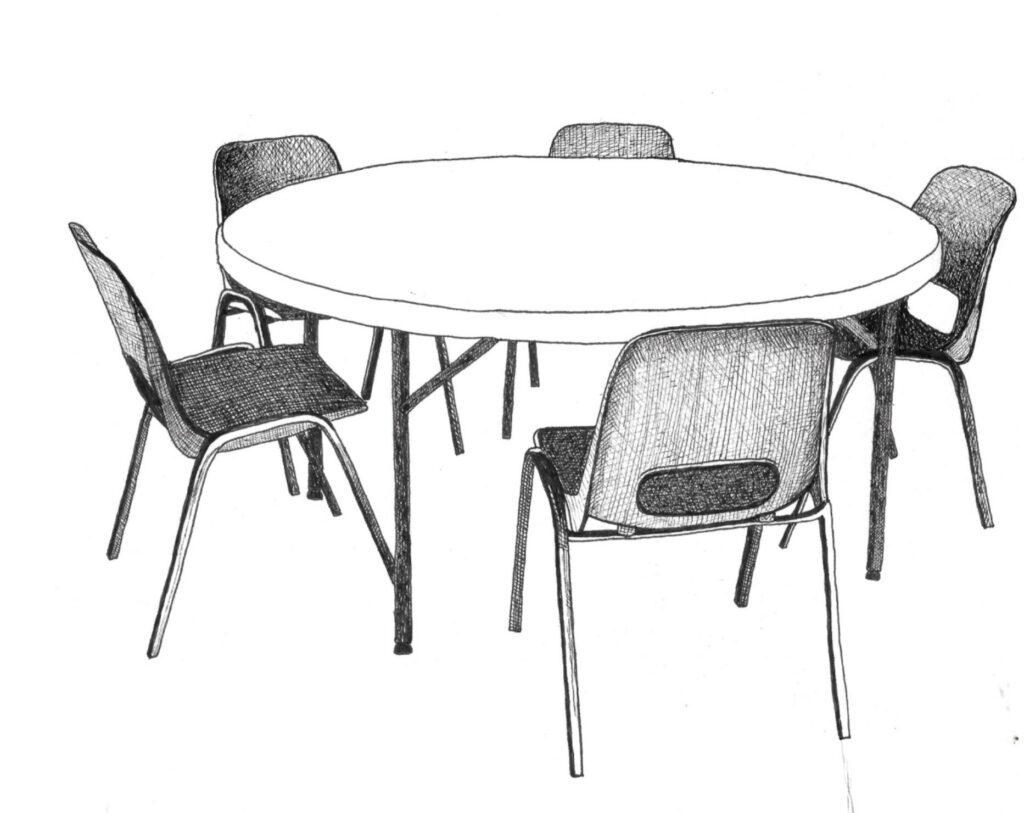
“Round table” by Alexis Bulman. Hand-drawn black-and-white illustration of a round table surrounded by five chairs.

Cross-Consultation Key Themes

Human Creativity, Value, and the Meaning of Art

Across all consultations, participants emphasized that human creativity carries intention, lived experience, cultural lineage, and emotional depth that AI cannot replicate. AI’s speed and “average-ness” flatten artistic expression into content, threatening the perceived value of human craft.

Copyright, Consent, and Uncompensated Extraction

A dominant theme was the widespread scraping of artistic work—images, writing, music—without permission. Participants described copyright confusion, inability to protect hybrid works, and the erosion of fair compensation. Many people felt that “scraping” (AI collecting content from the internet without permission) was akin to theft, and that opt-out mechanisms, or ways to say “do not collect or use my content,” were insufficient to protect creative work from use by AI.

Cultural Sovereignty, Indigenous Rights, and Colonial Reproduction

Participants repeatedly raised concerns about AI reproducing colonial archives, appropriating Indigenous designs, and generating fake Indigenous content. OCAP principles were invoked as essential safeguards. AI was seen as a new vector for cultural extraction and misrepresentation.

Environmental Impacts and Data Centre Expansion

Water use, land degradation, pollution, and opaque approval processes were major concerns in relation to AI data centres. Participants noted that AI has significant environmental effects and vulnerable communities—rural, disabled, low income—bear disproportionate environmental burdens. AI was described as an extractive industry with hidden ecological costs.

Labour Precarity, Job Displacement, and Bargaining Power

Creative workers—artists, designers, illustrators, game developers, editors—face job loss, devaluation, and pressure to compete with machine level productivity. AI accelerates expectations, undermines bargaining power, and contributes to burnout and editor fatigue.

Accessibility, Disability, and the Tension between Assistive and Harmful AI

AI offers some accessibility benefits (translation, alternative formats), but also reinforces the medical model of disability (which views disability as a personal, physical, or mental defect that needs to be fixed), increases productivity pressure, and replaces human supports that should exist. “Crip time,” which AI contradicts, emerged as a crucial concept for equitable timelines and expectations.

Education Gaps, Critical Thinking Decline, and Youth Impacts

Participants worried about declining writing skills, overreliance on automated tools, dopamine-driven screen habits, and the erosion of learning to learn and critical thinking. Youth and newcomers face both opportunities and risks, with digital literacy unevenly distributed.

Bias, Stereotypes, and Algorithmic Reproduction of Inequality

AI systems reproduce patriarchal, racist, and gender-based violence patterns embedded in training data. Participants noted “AI confirmation”—people accepting AI-generated answers as true without checking them, even when the answers may be biased or wrong—and the risk of AI amplifying harmful stereotypes at scale.

Transparency, Trust, and Invisible AI Adoption

AI is embedded in tools (for example, Canva, ATS systems, social media, grant portals) without disclosure. Participants feared penalties for using or not using AI, and worried about future scenarios where applicants generate funding proposals using AI and then funders assess them using AI systems.

Community Vulnerability, Rural Impacts, and Uneven Benefits

AI benefits some (for example, translation for newcomers, admin support for small businesses) but harms others (rural seniors, artists without tech literacy, marginalized communities). Participants stressed the need for peer-to-peer education and community-based learning.

Cultural Displacement, Misinformation, and Erosion of Trust

AI generated local news, tourism images, and social media content distort reality and displace human creators. Participants described uncanny, placeless images of PEI that threaten cultural distinctiveness and undermine trust in public information.

Sector Identity, Collective Advocacy, and Policy Gaps

Across consultations, participants called for unified arts sector advocacy, clear goals, and values-based policy. They noted slow government response, lack of AI expertise in public institutions, and the need for federal leadership. Basic income guarantee was repeatedly raised as an essential safety net to protect sectors against AI-related income loss and instabilities,

Working Assumptions

CreativePEI’s roundtables on arts, culture, and AI were conceived as peer knowledge exchange that is asset-based (starting from the understanding that everyone has knowledge and wisdom) and bi-directional (participants, facilitators, and partners all both contribute and learn).

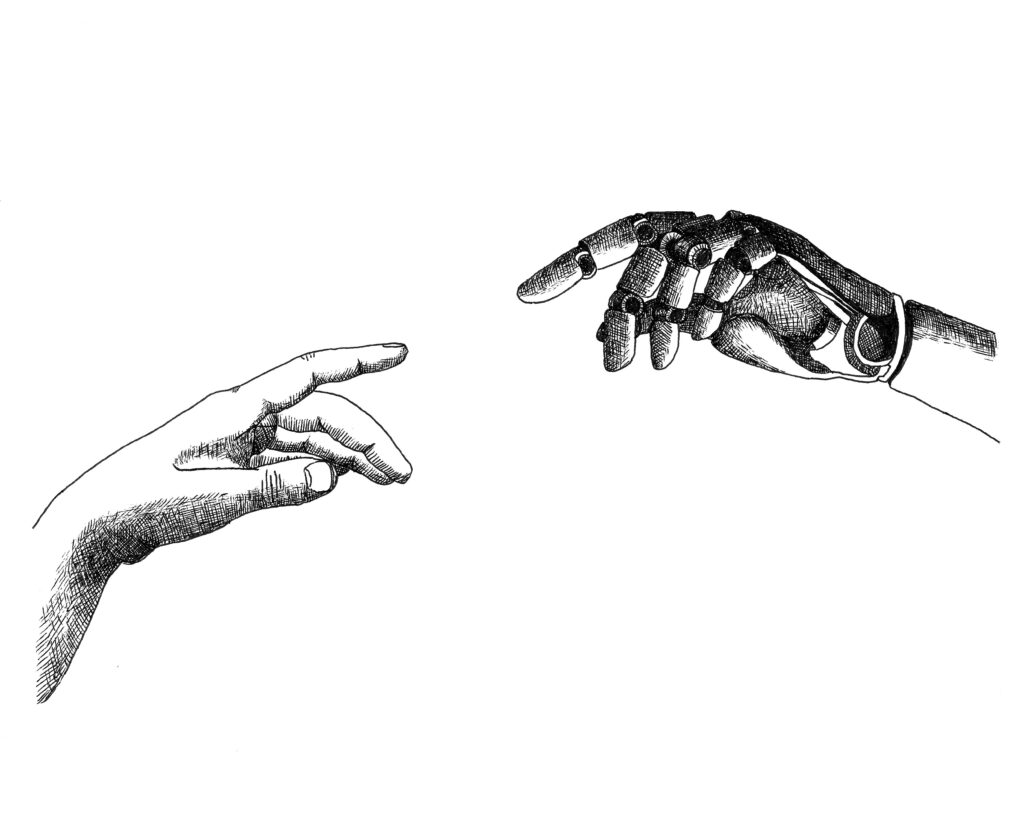
Illustration by Alexis Bulman: Hand-drawing of an AI-generated image, ink on paper, 2026. A black ink sketch against a white background shows a human hand reaching from the left toward a robotic hand extending from the upper right, with both index fingers nearly touching.

Starting assumptions:
● The arts and culture sectors (creative workers) can make a unique and necessary
contribution to the conversation around emerging AI practices.
● AI is not neutral; it reflects existing power structures and systems.
● Not all knowledge should be shared, recorded, or used in AI systems.
● Neither positive nor negative outcomes from AI can be presumed or predicted.
Shared goals (regardless of theme):
● Existing assets and practices already in the sector
● Shared risks and opportunities related to AI
● Tensions and divergences within the community
● Practical actions for readiness, such as policy and training needs
● Ethical considerations such as environmental impacts, Indigenous knowledge and protocol, and accessibility and inclusion.
ART Principles
Each roundtable shares the ART principles in the use of AI, as defined and promoted by the Canadian Arts Coalition
A—Authorization
R—Remuneration
T—Transparency
The Coalition advocates for the Government of Canada to ensure ART principles “are in place for artists for the use of their work, whether auditory, literary or visual, in all contexts, including for the training of generative artificial intelligence technologies and for any AI outputs.”

Discussion Summaries

Theme A: AI and Creative Labour, Rights, and Compensation - Charlottetown

What threats and opportunities do you observe related to AI and training data, copyright, consent, fair compensation, attribution, extraction, and creative workers’ bargaining power? What are the specific implications for consent of Indigenous communities, collective rights, and cultural ownership?

Participants expressed deep unease about how generative AI is reshaping creative work, with many describing a sense of erosion: of skills, of artistic value, and of human intention. Several speakers emphasized that AI’s speed and efficiency devalue the long learning processes and investment of time that define artists and artistic practice.

The roundtable participants expressed concerns about “scraping,” copyright violations, and the loss of bargaining power, with artists describing their work being taken without consent and used to train systems that undermine their livelihoods. Others highlighted existential discomfort: the idea that time spent engaging with art “created by no one” feels like a loss of human connection and meaning. The risk of human-created art being accessible only at a premium or only by an elite, like organic food, was discussed; this risk especially applied to writing and publishing.

At the same time, the group acknowledged tensions and nuance. A few participants noted that AI can lower barriers for beginners or help people without access to materials or training. Some saw limited, ethically constrained uses—such as working with public‑domain material or using AI in non‑creative problem‑solving domains like healthcare. Yet even these more positive views were tempered by worries about learning from “copies of copies,” the flattening of art into content, and the risk that AI accelerates disposability in creative industries, much like fast fashion.

Digital-artist participants also stressed that AI-generated work harms perceptions of digital art more broadly, lumping skilled digital creators together with automated output.

Across the discussion, participants repeatedly returned to power: corporate control, political agendas, environmental impacts of data centres, and the exploitation of low‑paid workers, especially in the global South, who sort training data. Many felt that AI’s trajectory is being set by those with economic and political influence, not by communities or creators. They raised concerns about lack of consent—especially for Indigenous communities and collective cultural knowledge —and called for organized advocacy, stronger regulation, and transparent policy processes.

The theme of historical precedents for significant technological change came up several times, with discussion of how artists and arts responded to oppressive systems through “underground” movements.

Participants expressed how much they valued participating in an in-person conversation about a topic they have only seen discussed online, in disembodied conversations. The discussion ended with a sense of solidarity and hope for resistance, community organizing, and the persistence of human creativity.

Theme A: AI and Creative Labour, Rights, and Compensation - Summerside

What threats and opportunities do you observe related to AI and training data, copyright, consent, fair compensation, attribution, extraction, and creative workers’ bargaining power? What are the specific implications for consent of Indigenous communities, collective rights, and cultural ownership?

Participants described AI as accelerating long‑standing pressures on creative workers—copyright vulnerability, uncompensated extraction, and declining bargaining power—while introducing new forms of cultural risk. Artists worried that putting work online now feels unsafe: images, designs, and writing are scraped into training datasets without consent, making it harder to maintain ownership or earn income. Several noted: AI collapses the time and labour behind creative practice, making human work appear “slow,” or “wasteful.”

Participants highlighted that this dynamic is especially harmful for emerging artists, surface designers, photographers, and writers whose fields are already precarious. Others emphasized that AI’s speed and opacity under-mine cultural sovereignty: fake Indigenous content circulates widely, Indigenous designs are reproduced by fast‑fashion platforms, and communities risk a loss of control over their stories, symbols, and protocols.

At the same time, participants acknowledged that AI presents complicated opportunities. Some have used AI for experimentation, for administrative tasks, or for curiosity‑driven creative play. Others noted that AI can help identify patterns, simulate scenarios, or support accessibility—though these benefits are overshadowed by concerns about hallucinations, misinformation, explosion of technology-assisted gender-based violence, and the erosion of critical thinking.

A key tension emerged: artists want to understand AI well enough to protect themselves, but not to become dependent on it or complicit in systems that exploit creative labour. Many expressed frustration that policymakers are moving too slowly, that governments lack AI understanding, and that new departments with “AI” in their titles lack meaningful expertise or mandate. Participants debated what realistic goals for advocacy might look like, given that “eliminating AI” is impossible but unregulated AI is unacceptable.

Overall, participants stressed the need for collective action, clear goals, and values‑based policy. They argued that meaningful consent—not opt‑out toggling—is essential, especially for Indigenous communities whose cultural knowledge is being appropriated in deepfakes. They called for basic income guarantees to buffer rapid labour disruption, for transparency in funding systems, and for regulations analogous to vehicle safety rules: AI should be treated as a powerful tool requiring oversight, training, and limits.

Participants also highlighted the cultural stakes: AI‑generated tourism images distort the landscape, flatten local distinctiveness, and risk erasing the very qualities that make PEI’s culture meaningful. For future advocacy focus, participants saw achievable policy levers, opportunities for cross‑sector collaboration, and a growing public appetite for ethical AI governance.

Theme B: AI as a Creative Collaborator—Or Not

How is AI actually being used (or rejected!) in creative practice. How in your observation does it affect tools, hybrid workflows, authorship, and artistic identity? How do artists avoid cultural appropriation at scale through AI tools?

Participants described a complex mix of curiosity, anxiety, and cautious experimentation with AI in creative practice. Several talked about using AI in limited, task‑based ways—cleaning up language, automating administrative work, or handling repetitive “donkey work”—while rejecting generative outputs in their core artistic practice. Some made a distinction between AI for creative work undertaken as a hobby and professional creative work.

Across disciplines, people noted that AI can speed up work but risks eroding the satisfaction, skill development, and cognitive benefits that come from doing creative work oneself. Several expressed fear that generative systems encroach on artistic identity, devalue human effort, and create new forms of burnout, especially in industries with relentless production demands.

Opinions diverged on authorship and originality. Some argued that all art is influenced by prior work and that AI is simply another remixing tool; others insisted that human intention, lived experience, and decision‑making remain irreplaceable. Copyright was a major point of confusion and frustration: artists worried about their work being scraped without consent, questioned whether hybrid human–AI works could be protected, and debated whether copyright itself might need to evolve or even dissolve.

Concerns extended to cultural appropriation at scale, especially when AI models reproduce styles or cultural motifs without context, permission, or accountability.

Underlying these debates was a broader unease about societal impacts: environmental harms from data centres, cognitive decline from over‑reliance on automated tools, job displacement in fields like gaming and illustration, threats to economic and democratic systems due to tech oligarchs, and the vulnerability of children and future generations to low‑quality AI‑generated media.

Yet the conversation also surfaced nuance—some participants found hope in community dialogue, saw potential for carefully bounded uses, or felt less polarized after hearing others’ perspectives. The group agreed that creative‑sector policy must be culturally informed, not purely technological or economic, and that boundaries, safeguards, and thoughtful norms are urgently needed.

Theme C: Access and Inclusion and AI in the Arts and Culture Sector

Who do you observe benefiting from AI, who is excluded, and what supports or policies are needed, especially for equity-deserving groups, as a result of emerging AI? How do AI risks balance with assistive potential, collaboration potential, or potential for language revitalization and access? What could digital sovereignty and equitable futures look like?

Participants described AI impacts (both opportunities and threats) falling unevenly across communities. Some artists and arts workers benefit from AI’s ability to reduce administrative burdens, translate text, or provide a sounding board when human support is inaccessible or unaffordable. For people facing barriers—disability, rural isolation, language minority status—AI can offer stopgap assistance. Yet many roundtable participants stressed that these uses of AI arise because human systems have failed: inadequate accommodations, inaccessible grant processes, unaffordable legal advice, and underfunded support networks push people toward AI out of necessity rather than choice.

At the same time, participants emphasized that AI amplifies existing inequities. Creative workers already struggling with precarious employment now face competition from AI‑generated content, rising productivity expectations, and opaque use of AI in funding applications. Indigenous communities face risks to cultural sovereignty when AI systems scrape data without consent, violating principles such as OCAP (Ownership, Control, Access, and Possession). Artists with disabilities noted that AI often reinforces the medical model of disability—treating individuals’ differences as problems to be “fixed”—rather than addressing structural barriers such as time, access, and community support. They discussed the need for reframing productivity and real-life application of “crip time” accommodation supports to benefit a wide range of disability types.

Environmental harms from data centres disproportionately affect vulnerable groups, and the normalization of AI in government systems without clear communication or guidelines leaves many feeling excluded, anxious, or penalized—whether for using it or for resisting its use.

Participants also explored possibilities for equitable futures. They pointed to examples of community‑controlled AI as models for digital sovereignty grounded in cultural values, environmental stewardship, and collective benefit. They envisioned policies that protect artists; uphold Indigenous rights in regard to land, data and culture; strengthen unions; and ensure transparency in public systems. Many expressed hope that collective action, shared advocacy, and clearer sector‑wide identity could counter feelings of isolation and help shape AI in ways that support human creativity rather than replace it.

Theme D: AI and Cultural Gatekeeping

How in your observation, does AI shape what gets seen, recommended, funded, archived, or remembered? Who controls metadata, description, and context? What are the risks of AI reproducing colonial archives and biases?

Participants described a widening gap between how AI is marketed and how communities actually experience it. Many noted that mainstream AI development is driven by elite tech interests, built on scraped data taken without permission, and now shaping everyday tools in ways most users don’t understand. This creates a landscape where artists, funders, and rural residents encounter AI without informed consent—whether through grant applications written by chatbots, AI‑generated local news, or automated résumé builders that misrepresent people’s skills. While some saw limited administrative benefits, the dominant feeling was concern: AI is being adopted casually, invisibly, and without the education needed to use it safely or ethically.

At the same time, participants expressed frustration with how AI reshapes cultural ecosystems. AI‑generated advertising (for example, the Burger Love controversy) sparked public backlash, suggesting some critical awareness—but AI‑generated local content (for example, What’s Up PEI) also circulates widely without people realizing it is synthetic. This raised fears about erosion of human creativity, loss of trust in public information, and the displacement of artists, graphic designers, filmmakers, actors, and cultural workers. Participants worried about funders receiving applications built with AI, about unclear ownership of submitted content, and about the possibility that future assessment processes could themselves be automated. Others highlighted how AI amplifies bias, reproduces patriarchal and racist patterns, and encourages “AI confirmation”—a feedback loop where people accept machine output without fact‑checking.

As pathways forward, the participants emphasized human‑centred approaches, community conversations, and peer‑to‑peer education as essential counterweights to AI’s rapid, opaque spread (though they were uncertain how to scale up these ground-level activities). They called for transparency in how AI is used, clearer guidelines for grant applications, and stronger digital literacy in schools. Many found reassurance in hearing others question AI rather than accepting it as inevitable. The discussion ended with a shared sense that collective action, sector‑wide coordination, and sustained public dialogue are needed to ensure AI supports rather than replaces human creativity.

Acknowledgements

AI Disclosure Notes

Humans generated the summaries and wrote the notes they are based on. Quotations may be paraphrases due to hand-written notes, but draft summaries and quotations were sent to session participants for review before publication.

A transcript of the virtual roundtable was generated and cleaned by Logical Outcomes AI, a Canadian service which does not retain content beyond one hour.

CreativePEI used anonymized notes/cleaned data in AI to test results: for example, to check summaries for missed themes and to curtail biases. We used AI to help compile and rank lists of themes from across the five roundtable sessions. All uses of AI are disclosed, and all results with AI content have been reviewed, edited, and finalized by humans.

Thanks

Thank you to all roundtable participants who generously shared their knowledge with their peers.

The CreativePEI team of May/June 2026 coordinated and delivered this project: Alexis Bulman, Becca Griffin, Jane Ledwell, Molly Leeco, and Noah Moss, with Career Bridges participant Zizhe Liu, and support from the Board of Directors.

A logo of abstract blue, green, and orange shapes representing Kings, Queens, and Prince counties overlap slightly to form the shape of the province Prince Edward Island. The words “PEI CREATES” appear below in bold, uppercase letters, with “PEI” in orange and “CREATES” in dark grey.

Roundtables and this report were made possible by Strategic Cultural Initiatives Funding gratefully received from InnovationPEI Cultural Development (PEI Creates), part of the PEI Department of Economic Development, Trade and Artificial Intelligence.